
Bank Charges in South Africa Explained: Every Fee on Your Statement (2026)
Monthly fees, ATM fees, deposit fees, "immediate payment" premiums, SMS charges — South African bank statements hide a dozen different fee types. Here's what each one means, how to find yours, and how to compare any two fee tables in ten minutes.

Quick answer: almost every bank charge in South Africa belongs to one of seven families: the monthly account fee, cash fees (ATM and deposits), payment fees (EFT and instant payments), card fees, notification fees, penalty fees, and service fees. Banks publish all of them — the problem is that fee tables are long, differently structured and full of jargon. This guide decodes each family, then gives you a ten-minute method to compare any two fee tables for your money habits, not the bank's marketing.
1. The Monthly Account Fee — the Price of the Door
The admin or account fee is charged whether you transact or not; think of it as rent for the account. It's also the number banks advertise hardest, because it's the easiest to make look small. The trap: a low monthly fee often pairs with high per-transaction charges, so "cheap" accounts can be expensive for active users. Judge it only together with the rest of the table. For reference, SOLmate's full fee table is public — the format every provider should use: one page, every fee, no asterisked mysteries.
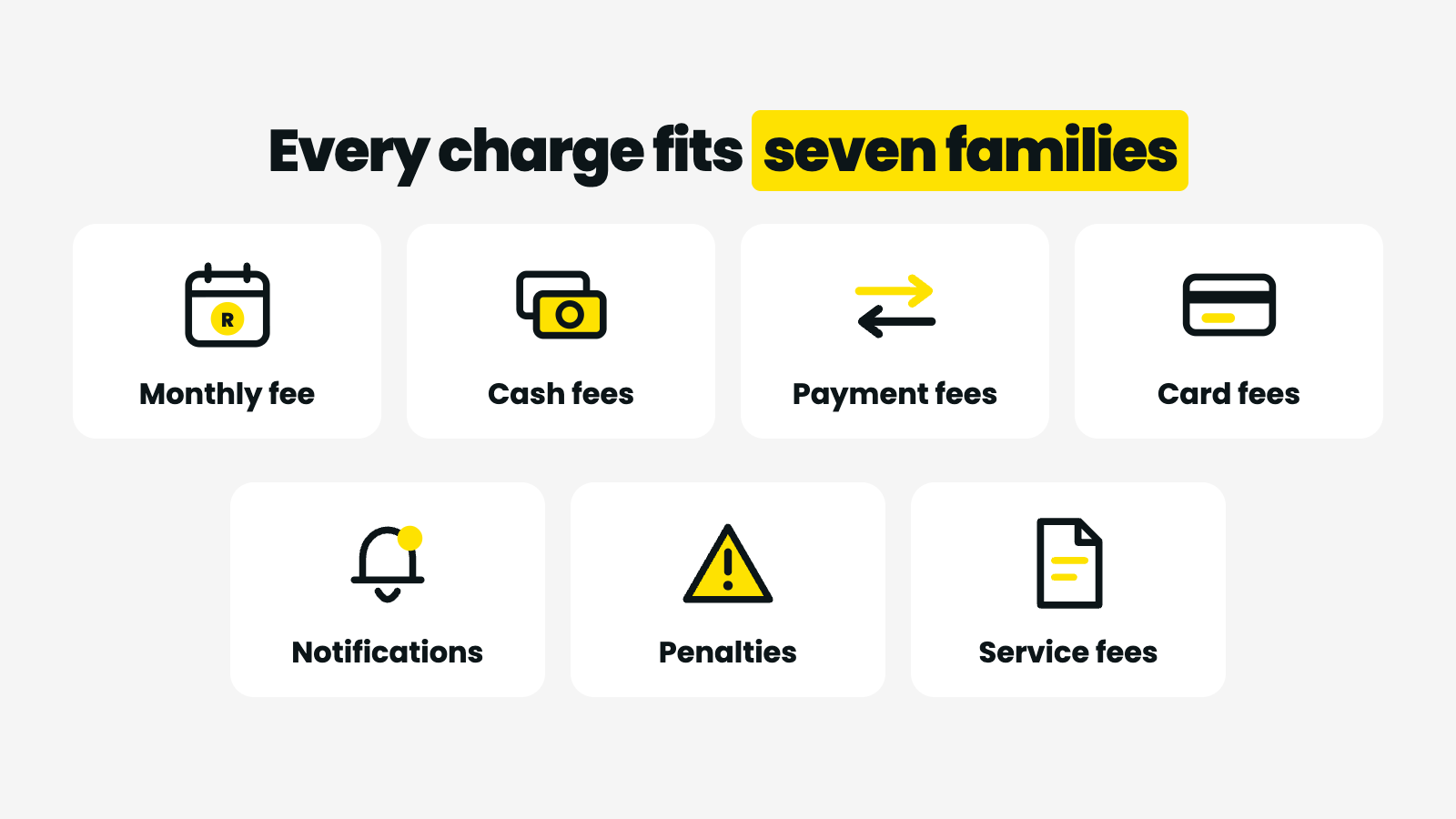
2. Cash Fees — Paying to Touch Your Own Money
Two charges live here: ATM withdrawals (typically priced per R100 or part thereof — so R210 out can cost the same as R300 out) and cash deposit fees (also per R100, because counting and moving physical cash costs banks real money). This family quietly dominates many people's total charges: if you're paid in cash or draw everything on payday, you can pay more here than the monthly fee itself. We've unpacked this one in detail in the hidden cost of cash — including the flat-fee alternatives at supermarket tills.
3. Payment Fees — Normal Speed vs Instant
Moving money electronically has two speeds and two prices. A standard EFT settles in batches (typically 1–2 business days) and costs little. An immediate payment — RTC, real-time clearing — lands in minutes and carries a premium at almost every provider. Neither is "better": the skill is matching the speed to the situation. Rent due tomorrow? Standard EFT sent today is free-ish and fine. Emergency at home right now? The instant premium is worth every rand. Debit order fees also sit in this family — including the nasty failed debit order penalty, which belongs in family six.
4. Card Fees — the Plastic Line Items
Issuing or activating a card, replacing a lost one, monthly card fees on some accounts, and occasionally per-swipe fees on entry-level products. Two questions to ask of any fee table: does the card cost something every month (recurring drag) and does tapping in a shop cost anything (it shouldn't — swiping your own card should be free, and on most modern accounts it is).
5. Notification Fees — Paying to Know
Some accounts still charge per SMS alert — R0.50–R1 per message sounds trivial until you multiply by every transaction for a year. App push notifications are free everywhere. If your account charges for SMS and you have a smartphone, switching the notification channel is the easiest fee cut you'll ever make.
6. Penalty Fees — Charges for Things That Didn't Happen
The least loved family: declined transaction fees (your card gets refused for insufficient funds — and you pay for the refusal), failed debit order fees (often the biggest single penalty on any table), and unpaid item charges. These are avoidable by design: balance checks before payments and debit orders aligned to payday kill most of them. If a fee table hides its penalty section, that itself tells you something.
7. Service Fees — the Long Tail
Printed or historical statements, dormancy fees on inactive accounts, special clearances, branch-assisted transactions that are free in the app. Individually small, collectively a reason to do in the app whatever can be done in the app — self-service is almost always the free lane.
The 10-Minute Method: Compare Fee Tables Like an Accountant
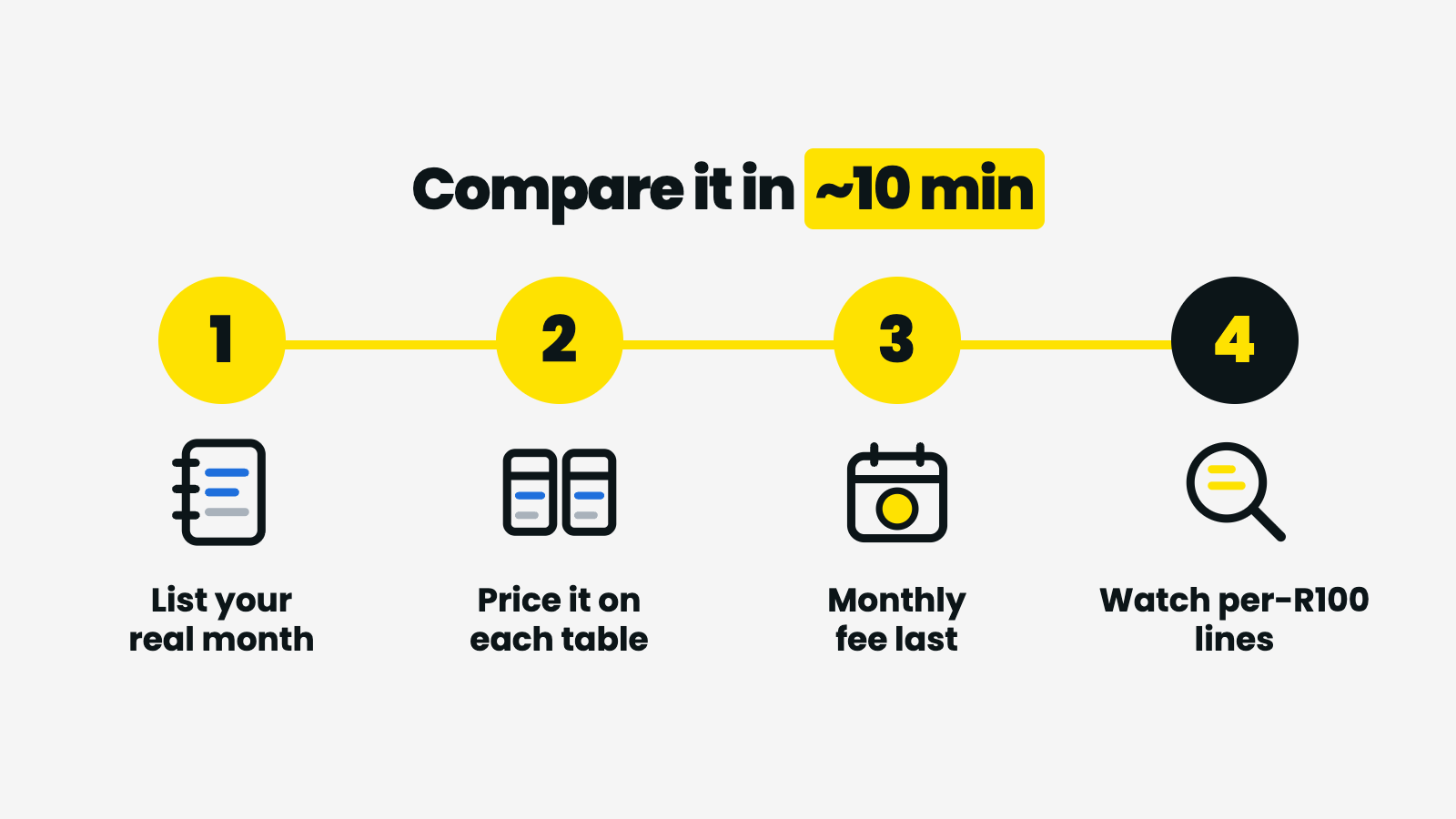
Comparing two banks line-by-line is a trap — tables are structured differently on purpose. Do it backwards:
- Write down your real month. How many cash withdrawals? Deposits? EFTs? Instant payments? Debit orders? SMS or app notifications? Be honest — use last month's statement.
- Price that month on table A, then table B. Ignore every line you never use. A fee you don't trigger costs nothing.
- Add the monthly fee last, not first — it's usually the smallest part of the real total for cash-heavy users.
- Watch the per-R100 lines hardest. They scale with your amounts; flat fees don't. The more cash you move, the more flat-fee structures win.
Ten minutes, one piece of paper, and you'll know more about your real banking costs than most people ever do. It's the same logic we recommend for comparing transfer costs: total cost for your pattern, not the headline number.
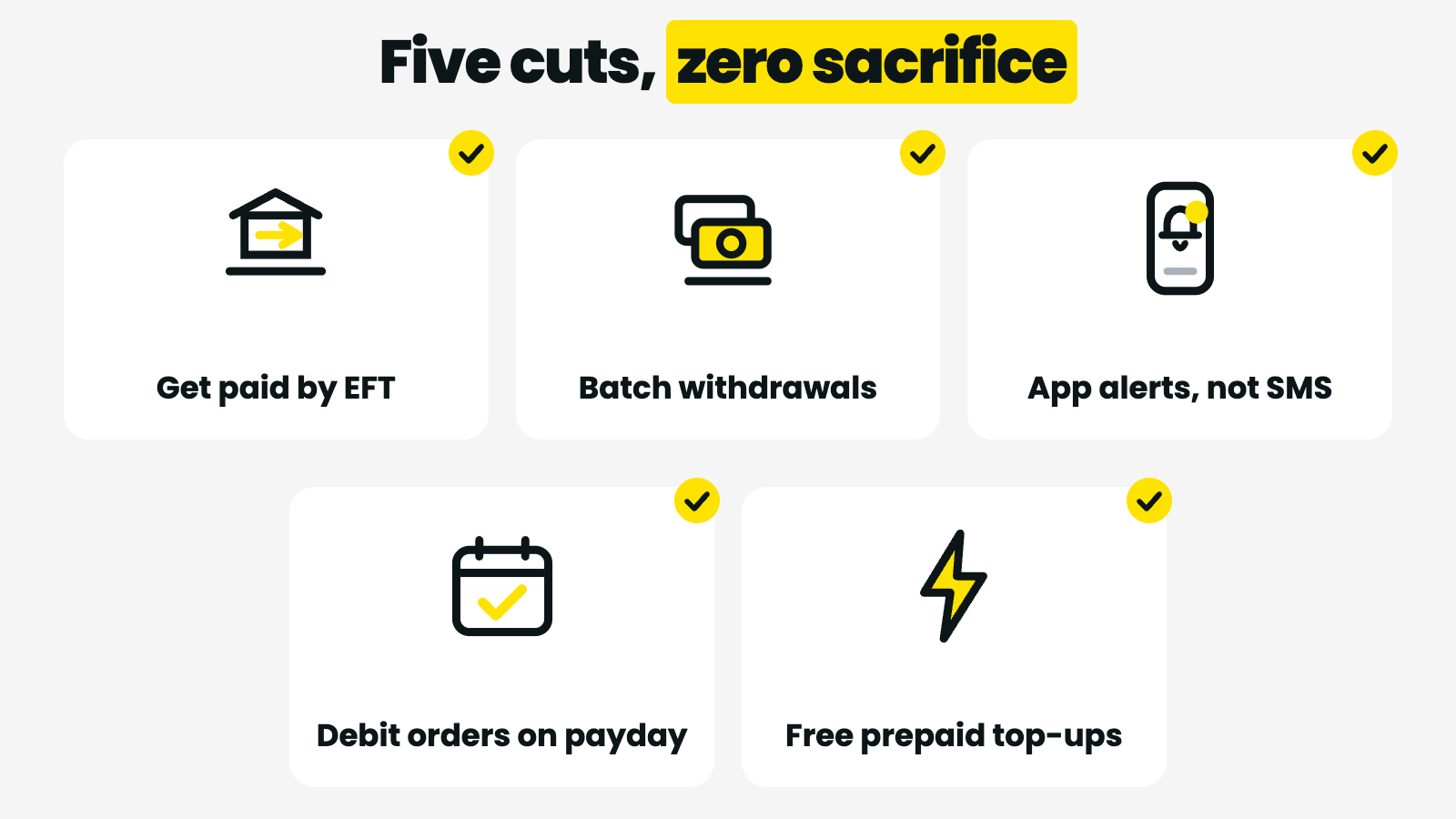
Five Fee Cuts That Work for Almost Everyone
- Get paid by EFT, not cash. Receiving EFTs is free at most providers — cash deposits never are. A salary paid into an account skips deposit fees entirely.
- Batch your cash withdrawals. One R1,000 withdrawal beats four R250 ones on per-transaction pricing — and flat-fee till-point withdrawals beat per-R100 ATM pricing as amounts grow.
- Switch SMS alerts to app notifications. Same information, zero cost.
- Align debit orders with payday. Failed debit order penalties are the most expensive avoidable fee on most tables.
- Buy airtime and electricity where it's free. Some providers charge nothing for prepaid purchases in-app — that's a real saving if you top up weekly.
What a Fair Fee Table Looks Like
You now know the seven families — so here's the standard to hold any provider to: every family disclosed on one public page, flat fees wherever possible, no charges for knowing your own balance, and no penalty fees buried in footnotes. That's the standard we hold ourselves to: the SOLmate fee table is one page, and the account behind it opens in about 3 minutes with a passport, SA ID or asylum permit — so checking whether your month prices cheaper on it costs you nothing but the ten minutes.
Frequently Asked Questions
What are the main types of bank charges?
Seven families: monthly account fee, cash fees (ATM/deposits), payment fees (EFT/instant), card fees, notification fees, penalty fees, and service fees.
Why does an instant payment cost more than an EFT?
It clears through a different real-time system and lands in minutes instead of 1–2 days — providers charge a premium for the speed. Pay it only when the same-day arrival actually matters.
Why do banks charge for depositing cash?
Physical cash costs money to count, move and secure; those costs get passed on per R100 deposited. Being paid by EFT avoids the fee entirely.
How do I compare two banks' charges?
Price your own real month — your actual withdrawals, deposits and payments — on each fee table, ignoring lines you never use. The right account is the cheapest for your pattern.
What's a declined transaction fee?
A penalty for a payment that didn't happen — charged when your card is refused for insufficient funds. Balance checks before paying avoid it.
Are wallet accounts cheaper than banks?
Often for cash-light, app-heavy usage — lower monthly fees, free prepaid purchases, flat cash fees. But run the same 10-minute test; "cheaper" always depends on your month.
Sources: SOLmate fee table, SOLmate fees help page. Fee structures described are general patterns across South African providers; check your own provider's current pricing guide for exact figures. Details correct as of August 2026. SOLmate is not a bank. SOLmate (SOL Ecosystem (Pty) Ltd) is an authorised financial services provider (FSP No. 52248) and registered credit provider (NCRCP16037).